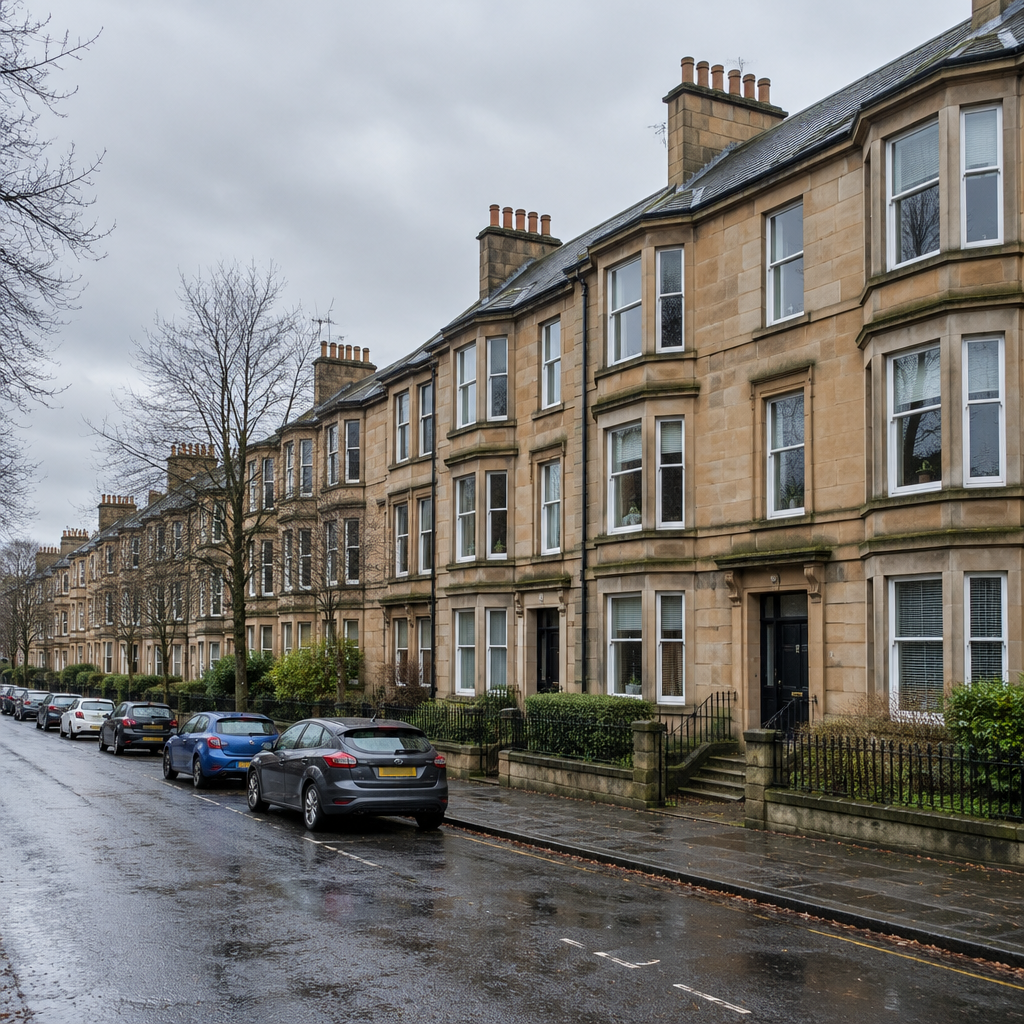
Glasgow Property Market Update: Autumn 2026
The official figures for August 2026 landed on 21 October, and they tell a story most Glasgow sellers will not like hearing. Scotland's average house price rose 2.9% over the year to £198,397. Glasgow managed 1.8%.
That is not a disaster. But it is a gap, and it matters if you are pricing a flat in Dennistoun or a semi in Cathcart right now.
The numbers, straight
According to the UK House Price Index for Scotland, published by HM Land Registry on 21 October 2026, the average property in the City of Glasgow sold for £194,382 in August 2026, up from £190,997 a year earlier. Provisional figures, as always, but directionally sound.
Set that against what happened around us:
- East Dunbartonshire: £273,891, up 4.3%
- South Lanarkshire: £186,196, up 3.9%
- North Lanarkshire: £161,163, up 3.9%
- East Renfrewshire: £303,413, up 2.7%
- Renfrewshire: £157,738, down 5.2%
- West Dunbartonshire: £132,345, up 7.9%
Glasgow sits third from bottom of that list. The towns we mentally file as "cheaper than the city" have outperformed the city itself.
Why the commuter belt is winning
Three things are happening at once, and none of them are mysteries once you look at the type of housing shifting.
First, flats. Across Scotland, flats and maisonettes rose 2.0% to an average £138,886, the weakest of any property type. Terraced houses rose 4.2%, semis 3.8%. Glasgow has a far higher proportion of its stock in flats than East Dunbartonshire or East Renfrewshire does. When the flat market lags, Glasgow's average lags with it. That is arithmetic, not decline.
Second, the mortgage maths pushed buyers outward. A couple with a decent deposit who could stretch to a two-bed tenement flat in Shawlands in 2021 can now buy a three-bed semi with a garden in Cambuslang or a new-build in Newton Farm for similar money. The railway did the rest. If you can be in Central in twelve minutes, the calculation changes.
Third, the Home Report and energy efficiency. Older Glasgow stock carries damp, single glazing and EPC ratings that buyers now interrogate properly. A 1905 tenement flat with an E rating is a harder sell than the same square footage in a 2015 estate with a B, even when the tenement is the better building.
What this means if you are selling
Do not read "Glasgow at 1.8%" as "my flat is worth less". Read it as "the market is differentiating hard, and it will punish a lazy price".
The city average is a blend of Govan and Dowanhill. It tells you almost nothing about your street. What it does tell you is that buyers in Glasgow are no longer paying a blanket premium for the postcode. They are paying for condition, energy rating, and the specific things your flat has that the one two closes down does not.
Price to the market you are actually in
The sellers struggling right now are, almost without exception, the ones anchored to a valuation from 2022 or an asking price copied from a neighbour's listing rather than a neighbour's sale.
In a market where the city average moves 1.8% and the spread between local authorities is fourteen percentage points, the only pricing that works is evidence-based. Sold prices, same street, same type, last six months. Anything else is a guess dressed up as a strategy.
If you want a proper read on that, our Glasgow estate agent page covers how we price across the southside, the west end and the east end differently, because they behave differently.
Presentation is doing more work than it used to
When money is tight and choice is wide, buyers filter before they view. They filter on photographs and on the EPC. A flat with dark hallway shots and no floorplan does not get a viewing, and a property with no viewings does not get an offer.
This is where the sellers who beat the average are winning. Not with a clever price, but with the boring stuff done properly: decluttered rooms, decent light in the photos, a floorplan that makes sense, a Home Report that arrives before the buyer has to ask.
Our guide to selling your house fast in Glasgow without dropping the price goes through that in detail.
The honest caveat
One month is not a trend. The August figures are provisional and will be revised, and the Index itself warns against reading too much into a single month. Glasgow at 1.8% after sitting at 5% two years ago is a slowdown, not a crash, and volumes are the thing to watch. Across Scotland, transaction volumes in June 2026 were 4.4% down on June 2025. Fewer sales completing, prices holding roughly level: that is a standoff, not a collapse.
The practical consequence of a standoff is simple. Well-priced, well-presented property still sells quickly. Everything else sits, gets stale, and ends up reducing anyway, having lost the first four weeks when buyer attention is highest.
If you are thinking about a spring sale, the work starts now, not in February. Getting the Home Report, the EPC and the repairs sorted in the quieter months is what lets you launch into demand rather than scramble for it.
Next step
If you want to know what your own property is worth in this specific market, rather than the city average, book a free valuation. We will look at your street, your type, your condition, and give you a figure we are prepared to defend with evidence.
And if you are still at the research stage, our guide to how much your home is worth explains what actually drives the number in Scotland, Home Report included.